How AI decides what to recommend
💡 Get discovered in AI answers and create humanlike voice experiences

Hello Readers 🥰
Welcome to today's edition, bringing the latest growth stories fresh to your inbox.
If your pal sent this to you, then subscribe to be the savviest marketer in the room😉
In Partnership with Templafy
Your AI is generating content your brand team never approved.

That deck someone sent to a prospect last Tuesday. The proposal that went out with last year's messaging. The pitch built from a template nobody updated. It happens every day, and marketing is the last to know.
Templafy fixes this at the source, before the wrong content ever gets built. Your brand rules, approved content, and compliance guardrails are built into the AI itself.
Every document your team generates follows them automatically, whether they're in PowerPoint, Word, or Google Workspace.
- Every AI-generated document follows your brand rules from the first slide
- No rogue content, outdated messaging, or off-brand assets reaching clients
- 4M+ users at KPMG, PwC, Adobe, Cisco, and Pandora running on it
BDO saved $1.65M in a year. Adobe teams got back 72% of their time. The output your team generates tomorrow will look exactly the way your brand demands it to.
📝 Win Visibility in the Age of AI Search
Insights from Demand Curve
Search has changed. Traditional SEO focused on rankings, links, and positions. But AI search works differently. It does not rank pages. It recommends answers. Instead of showing ten blue links, it generates a shortlist based on what it “knows” about your brand across the internet.
That shift changes how visibility works.
Steps to Improve Your AI Search Presence:
1️⃣ Focus on Reputation, Not Rankings: AI evaluates your entire digital footprint. Your website, reviews, mentions, and discussions all shape how the model understands your brand. Strong, consistent signals matter more than a single optimized page.
2️⃣ Test Across Multiple Models: Each AI system sees the internet differently. You might appear in one and not in another. Run key customer queries across multiple platforms and track where you show up.
3️⃣ Analyze How You Are Described: Do not just check visibility. Study the description attached to your brand. This is your positioning as understood by AI. If it is vague or incorrect, it signals a deeper issue.
4️⃣ Identify Your Gaps: When competitors appear and you do not, look for the reason. It usually comes down to three gaps: lack of content coverage, inconsistent messaging, or weak positioning. Fixing these improves how AI understands you.
5️⃣ Prioritize High-Intent Queries: Start with searches closest to purchase decisions. Comparisons, alternatives, and best-for queries matter most. Improving visibility here drives real impact.
The Takeaway: AI search rewards clarity, consistency, and specificity. It is no longer about ranking higher. It is about being understood better. Brands that communicate clearly across every touchpoint will win recommendations, while others fade into the background.
📝 Build Realistic Voice AI with Voxtral TTS
Insights from Paul AI
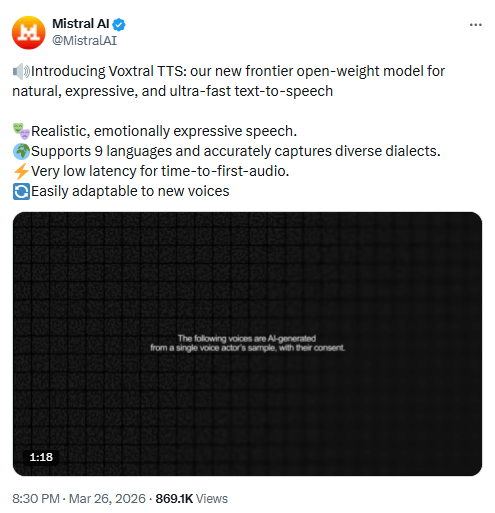
Voice AI is evolving fast, but most models still fall short when it comes to realism and control. That is starting to change. Mistral has introduced Voxtral TTS, an open-weight text-to-speech model designed to deliver expressive, high-quality voice generation with surprising efficiency.
Steps to Use Voxtral TTS Effectively:
1️⃣ Start with a Lightweight Model: Voxtral TTS runs on just 4B parameters, making it significantly more efficient than many alternatives. This means faster performance and easier deployment without heavy infrastructure.
2️⃣ Generate Realistic Speech: The model produces natural, human-like audio with emotional depth. It captures tone, pauses, rhythm, and personality, making outputs feel less robotic and more conversational.
3️⃣ Support Multiple Languages: You can generate speech across 9 languages while maintaining clarity and authenticity. It also adapts well to different dialects and accents.
4️⃣ Clone Voices with Minimal Input: With just a few seconds of audio, you can replicate a voice. This allows for rapid customization and personalized voice experiences without large datasets.
5️⃣ Leverage Cross-Lingual Adaptation: One of its strongest features is the ability to carry voice characteristics across languages. For example, you can generate English speech with a French accent while preserving the original voice style.
6️⃣ Optimize for Speed and Scalability: Low latency ensures quick time-to-first-audio, making it ideal for real-time applications like assistants, narration, or interactive tools.
The Takeaway: Mistral’s Voxtral TTS brings together efficiency, realism, and flexibility in a way that makes advanced voice AI more accessible. With open weights and strong performance, it opens the door for developers and creators to build faster, more expressive voice-driven experiences without heavy constraints.
We'd love to hear your feedback on today's issue! Simply reply to this email and share your thoughts on how we can improve our content and format.
Have a great day, and we'll be back again with more such content 😍