The Hidden Cost of Sameness
🤖 Why AI content sounds the same, plus how to fine tune your own model

Hello Readers 🥰
Welcome to today's edition, bringing the latest growth stories fresh to your inbox.
If your pal sent this to you, then subscribe to be the savviest marketer in the room😉
In Partnership with Stack Influence
This Channel Turned a Sunscreen Brand's #42K Amazon Ranking Into a Bestseller in 4 Months
Naked Sunday had a decent SPF product buried on page 4. So they stopped bidding and started seeding, sending free product to micro-influencers with no cash changing hands.
Four months later, monthly units went from 131 to over 1,300, rank jumped 2.4x, and 252 creators pushed 1.4M impressions, with a 22% testimonial rate still fueling the listing today.
Stack Influence runs this exact motion. Their AI matches your brand with creators from a network of 11M+ micro-influencers, and you simply pay them only with your products, so every dollar maps to a real purchase and a real piece of content.
- Lenny & Larry's seeded 1,560 creators for 11x monthly sales
- Blueland grew Amazon sales 372% with a 6.3x rank lift
- Dreamland Baby turned one campaign into $150K from a standing start
Now you can run the same motion and save 10% on your first campaign if you sign up this week.
Book a free demo call and get started today.
📝 Why AI Makes Everyone Sound the Same
AI is brilliant at finding the most probable answer, and that is exactly why it struggles with marketing. Marketing's job is to be the least probable thing in someone's feed, while AI is built to predict patterns. Here's what that means for your brand.
1️⃣ Consensus vs Differentiation
LLMs predict the next most likely word, which works great for accuracy tasks like SQL queries or legal summaries. But marketing needs to break patterns, not follow them, so the most probable content quickly becomes the most forgettable content.
2️⃣ The Evidence Is Piling Up
At RSAC 2026, 45.7% of booths led with AI messaging and almost the same share used blue as their primary brand color. When Italy briefly banned ChatGPT, content became 15% less similar across platforms and engagement rose 3.5%, showing how AI narrows creative variety when it disappears, that variety returns.
3️⃣ Three Layers of a Business
Think kitchen, dining room, and concept. AI handles the kitchen (ops, logistics, scheduling) well, since consistency is the goal. It hurts more in the dining room (presentation, tone). It does the most damage at the concept layer, where positioning and voice should stay human led.
4️⃣ The Compounding Advantage
As more companies let AI define their strategy, genuine distinctiveness becomes rarer and more valuable. Anthropic is hiring storytellers even as competitors cut marketing teams, a sign that a real voice will keep beating a consensus one.
Takeaway
AI is a powerful tool for accuracy and speed, but strategy and voice still need a human point of view. Use AI in the kitchen, stay careful in the dining room, and keep the concept entirely yours.
📝 Fine Tune Your Own AI Model for YOUR Needs
You do not always need the biggest general purpose model. For many workflows a small specialized model trained on your own data can outperform general models like the ones from Anthropic or OpenAI. Here is how fine tuning gives you a model built specifically for your tasks.
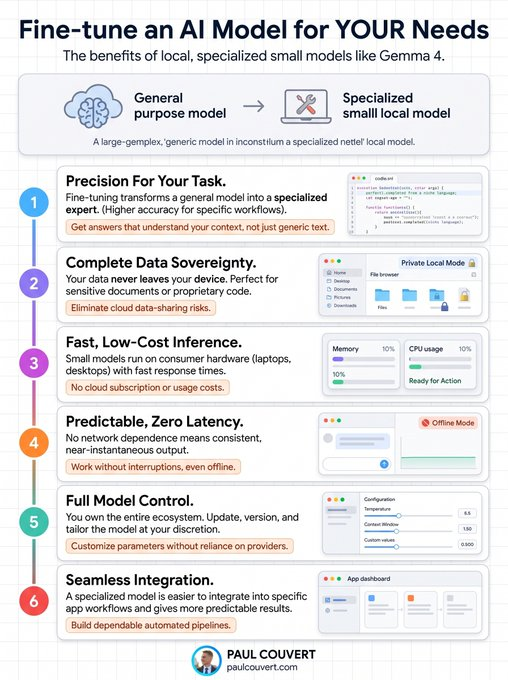
1️⃣ Get Precision For Your Task
Fine tuning transforms a general model into a specialized expert with higher accuracy for your specific workflows. Instead of generic text, you get answers that actually understand your context.
2️⃣ Keep Complete Data Sovereignty
A locally run model means your data never leaves your device. This is ideal for sensitive documents or proprietary code, since it eliminates cloud data sharing risks.
3️⃣ Enjoy Fast, Low Cost Inference
Small models run well on consumer hardware like laptops and desktops, giving you fast response times with no cloud subscription or usage based billing to worry about.
4️⃣ Rely on Predictable, Zero Latency Output
Since there is no network dependence, you get consistent, near instantaneous responses. Your workflow keeps running without interruptions, even completely offline.
5️⃣ Take Full Model Control
You own the entire ecosystem. Update, version, and tailor the model at your own discretion, customizing parameters without depending on any provider.
6️⃣ Build Seamless Integration
A specialized model is easier to integrate into specific app workflows, giving you more predictable results and dependable automated pipelines.
The Takeaway
Gemma 4 and Qwen 3.5 or 3.6 are strong base models for this, and tools like Unsloth Studio make fine tuning them straightforward. If you want a model that truly understands your tasks, works offline, and keeps your data private, fine tuning your own small model may serve you better than relying on a general purpose one.
We'd love to hear your feedback on today's issue! Simply reply to this email and share your thoughts on how we can improve our content and format.
Have a great day, and we'll be back again with more such content 😍