Find the Claim Only You Own
✅ Why buyers cannot tell you apart, then a small AI model proving size is not everything

Hello Readers 🥰
Welcome to today's edition, bringing the latest growth stories fresh to your inbox.
If your pal sent this to you, then subscribe to be the savviest marketer in the room😉
In Partnership with Insense
Save 40+ hrs/month in Q4 on UGC creator & influencer operations
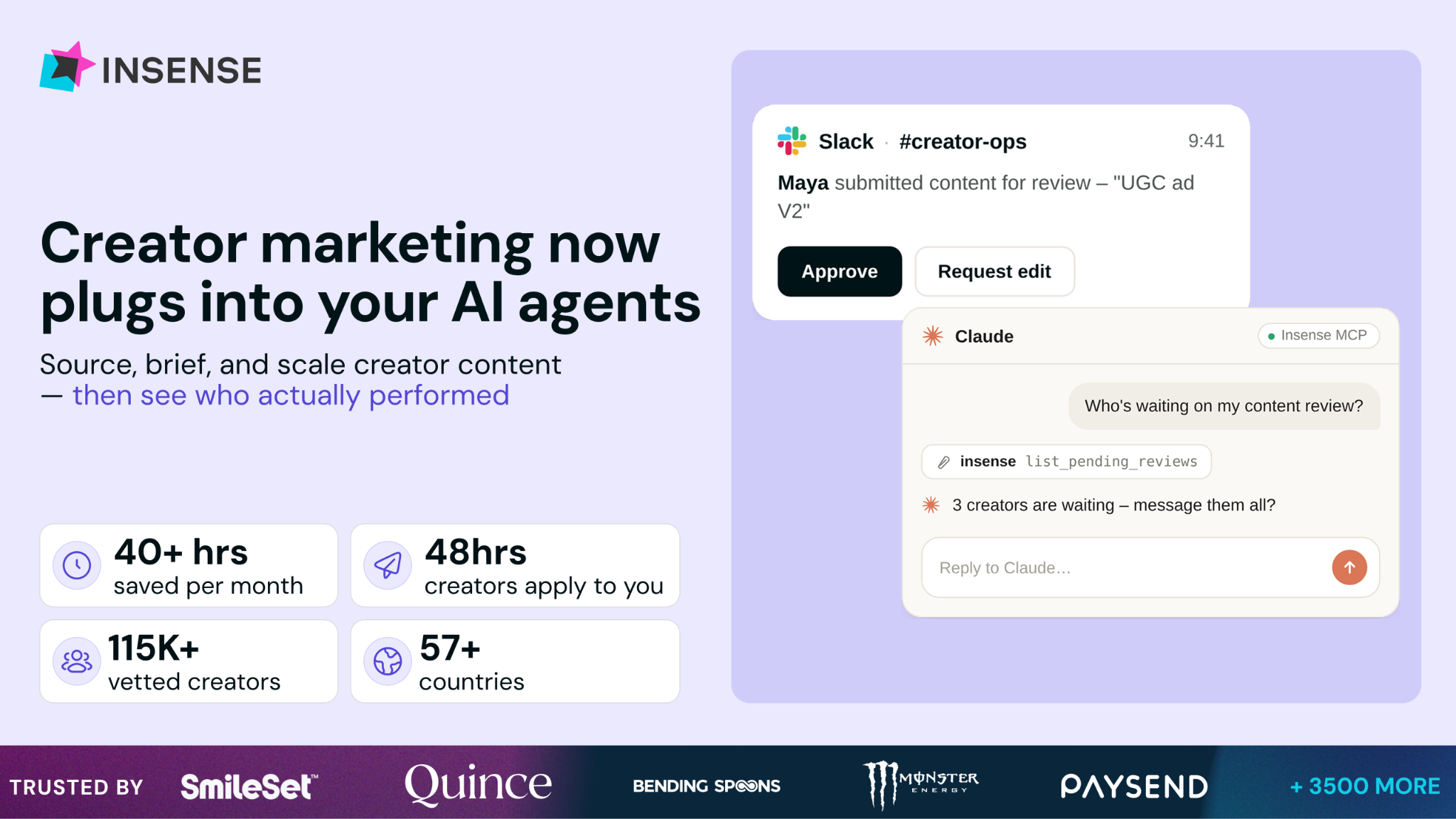
Your team already runs on Slack and AI agents. Your creator marketing should too.Insense now plugs into the stack you already use, so you brief, approve, and track creator work without living in yet another dashboard.
Route campaigns and updates through Slack, put your AI agents (ChatGPT, Claude) to work on briefs and shortlists, and keep everything connected to your Ads Manager and analytics.Underneath, the creator layer runs itself:
- Vetted creators apply to you within 48 hours - from a vetted marketplace of 115K+ creators across 57+ countries
- Run diverse campaign types - from UGC to seeding, influencer posting, and Meta Partnership Ads and TikTok Spark Ads
- Get creator performance insights - connect your Ads Manager and view which creators perform best - not only which ads
Over 3,500 brands and agencies use Insense, with first creator applications arriving within 48 hours and teams saving 40+ hours monthly.
Book a free strategy call by Sept 25th and get $200 towards your first campaign.
📝 The Tie You Do Not Know You Are In
A buyer compares your product to a competitor and your product is genuinely stronger. Then they read both websites and see the same lines everywhere. Save time. All in one place. Trusted by fast growing teams. The comparison quietly becomes a coin flip, and coin flips get settled by familiarity and price, not by who actually builds the better product.
Here is why this keeps happening and how to fix it:
1️⃣ A Benefit Is Not a Reason
Claims like save time or built for scale are benefits, true of nearly every company in the category. A real value prop answers a harder question: out of every option available, why you specifically. If a competitor could swap in their name and the line still holds true, it is a benefit, not a position.
2️⃣ One Weak Claim Spreads Everywhere
Whatever line sits at the top of a homepage becomes the seed for ads, onboarding emails, and sales decks. When a bland claim underperforms, the blame usually lands on the channel instead of the message, so the same seed gets replanted and the results repeat.
3️⃣ Build the Claim from Failures, Not Words
List the bad alternatives customers actually use instead of you, spreadsheets, manual workarounds, doing nothing, and write down exactly what breaks with each. Answer those specific failures directly, then keep only the claims that are true of you, hard for a competitor to honestly copy, and important to the buyer.
The Takeaway
A strong product can still lose because its message sounds like everyone else's. A real value prop is not written by admiring competitor copy or asking AI for the safest sentence, it is built by tracing a customer's specific failure back to words only you can honestly own.
📝 This Tiny 2B Model Runs Agents Fully Offline
A small local model is turning heads for a simple reason, it is genuinely good despite its size. MiniCPM5-2B has only 2 billion parameters, runs fully offline on a laptop or even a phone, and needs just 2GB of RAM. It is fully open source and can handle coding, agentic, and tool use tasks that usually require far larger models.
Ok this small local model is sooo good
— Paul Couvert (@itsPaulAi) September 9, 2026
MiniCPM5-2B has only 2B parameters (!!) and can run agents on any laptop or even your phone fully offline.
This 100% open source model can perform coding/agentic/tool use tasks and can run on just 2GB RAM!
And it's genuinely good even in… pic.twitter.com/es31TX5Ois
Here is what makes it stand out:
1️⃣ It Actually Completes Agent Tasks
Running through the Hermes agent framework, MiniCPM5-2B was asked to visit Hugging Face, navigate to the Models section, evaluate models across multiple criteria, and output a CSV of the top 15. It completed the full task chain on its own.
2️⃣ It Leads Its Size Class
In the Artificial Analysis Intelligence Index v4.1.1 results cited in the official release, MiniCPM5-2B scores 23 and ranks first among open source models under 4 billion parameters, even outperforming some models roughly six times its size on select evaluations like GDPval AA v2.
3️⃣ Intelligence Density Is the New Race
Researchers from Tsinghua University and ModelBest introduced the Densing Law, showing that the maximum capability density of open source pretrained models has roughly doubled every 3.5 months. Size is becoming less important than how much intelligence a model packs per parameter.
4️⃣ Openness Goes Beyond Weights
OpenBMB is releasing more than just the model itself. Training methods, agent related data, data refinement resources, and even the reinforcement learning stack, including Meshy and JustRL II, are being opened up alongside it.
The Takeaway
MiniCPM5-2B is a sign that the next wave of useful AI may not come from bigger models, but from denser ones. A 2B parameter model running real agent workflows offline on a phone suggests capability is catching up to accessibility faster than expected.
We'd love to hear your feedback on today's issue! Simply reply to this email and share your thoughts on how we can improve our content and format.
Have a great day, and we'll be back again with more such content 😍