Your Messaging Is Overloaded
🔍 How micro beliefs drive conversions plus an instant attention audit for your homepage

Hello Readers 🥰
Welcome to today's edition, bringing the latest growth stories fresh to your inbox.
If your pal sent this to you, then subscribe to be the savviest marketer in the room😉
In Partnership with Lindy
Give Your Marketing Team Superpowers with AI Agents
Lindy AI CMO is a suite of powerful agents that ship beautiful marketing campaigns quickly.
Simply enter your business's website, and watch AI agents study competitors, create messaging docs and campaign briefs, and generate creative assets. Everything is automatically organized in Airtable, ready to deploy.
With Lindy, marketing isn't a grind; it's a system that runs 24/7, handling strategy, analysis, and creative work while you focus on growth.
See AI Agents in Action today!
🧩 Buyers Convert Through Micro Beliefs
Most funnels fail because they ask for too much, too soon. Teams try to cram a full pitch deck into a top-of-funnel ad, a homepage hero, or a first email. They explain what they are, who they are for, the problem, the solution, and why it is urgent.
Buyers do not decide in one leap. They move through micro beliefs in order: this is my problem, this is for people like me, they are credible, this is different, and this feels safe to try. Your job is to earn one belief at a time.
That is where the Rule of One helps. Every asset should create one belief and drive one action. If you cannot describe the one belief your ad or page is building in a single sentence, you are overloading it.
Steps to Build a Micro Belief Funnel Map:
1️⃣ Top of Funnel Hook
Goal belief: This is my problem.Your message should name the pain or tease the outcome. Keep it simple and specific.
2️⃣ Mid Funnel Story
Goal belief: This works, and it is different.Explain how you solve the issue and what makes your approach distinct. Do not dump features. Give a clear narrative.
3️⃣ Bottom Funnel Risk Removal
Goal belief: This is safe to test.Remove friction with a low-commitment next step. Reduce uncertainty with clear terms and easy onboarding.
4️⃣ Post-Purchase Payoff
Goal belief: it delivered.Reinforce the promise with quick wins, progress signals, and prove the buyer made the right call.
5️⃣ Audit For Overlap
Common mistakes include a homepage that tries to explain everything, ads that list too many features, and awareness messages that push a high-friction CTA. Move those elements into the correct stage.
The Takeaway
The goal is not to say more. It is to say the right thing at the right moment. Build a sequence where each touchpoint earns one belief and hands the buyer over to the next step.
🔥 Run an Instant Attention Audit on Your Webpage
Most landing pages do not fail because the offer is weak. They fail because attention leaks. Visitors look at the wrong thing first, get pulled into distracting elements, and never reach the main CTA with enough momentum to click.
This workflow helps you predict where eyes will go above the fold, then redesign your hero section to funnel attention toward one conversion goal. The result is a cleaner first impression, fewer distractions, and a stronger path to action.
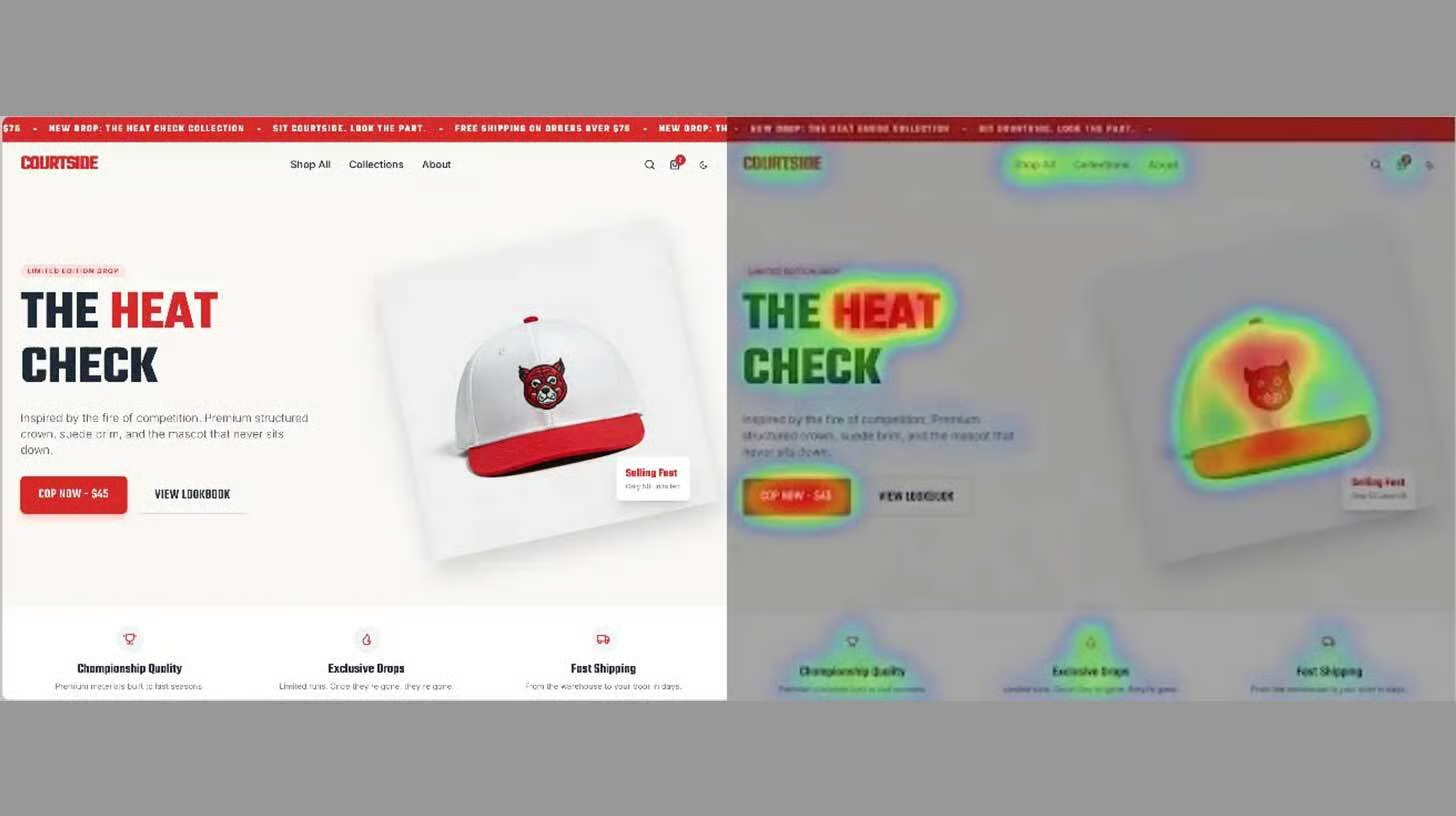
Steps to Predict Attention and Improve Your Hero Section:
1️⃣ Sign In and Prep Your Session
Open Google Stitch and start a fresh session. You will use it to generate a redesigned hero section based on attention data.
2️⃣ Capture Your Above-the-Fold Screenshot
Take a clear screenshot of your hero section. Include the headline, subhead, visuals, and primary CTA. This is the area that decides whether visitors stay or bounce.
3️⃣ Generate a Predictive Heat Map
Open Google AI Studio and upload your screenshot. Then prompt it to create a predictive attention heat map overlay. Update the CTA text in the prompt so it matches your page exactly. The goal is to highlight what draws the most focus and what steals it from the primary button.
4️⃣ Redesign the Hero With Stitch
Drop both the original screenshot and the heat map into a new Google Stitch session. Toggle to start with a new web design. Then prompt Stitch to redesign the hero section to maximize click-through rate on the primary CTA using the heat map insights to remove distractions and concentrate focus.
5️⃣ Compare Multiple Scenarios
Run the same process with variations. For example, different headlines, different hero images, or a simplified layout. Comparing outputs helps you spot repeatable attention patterns you can use across future pages.
The Takeaway
Conversion wins often come from directing attention, not adding more elements. Predict where focus goes, remove what competes, and design the hero around one job: getting the click.
We'd love to hear your feedback on today's issue! Simply reply to this email and share your thoughts on how we can improve our content and format.
Have a great day, and we'll be back again with more such content 😍