Why Creative Beats Audience Targeting
🎯 Target with creative not audiences plus AI handles product photography

Hello Readers 🥰
Welcome to today's edition, bringing the latest growth stories fresh to your inbox.
If your pal sent this to you, then subscribe to be the savviest marketer in the room😉
In Partnership with Grapevine
📉 Consumers Are More Media-Savvy Than Ever. Here's What Still Converts.
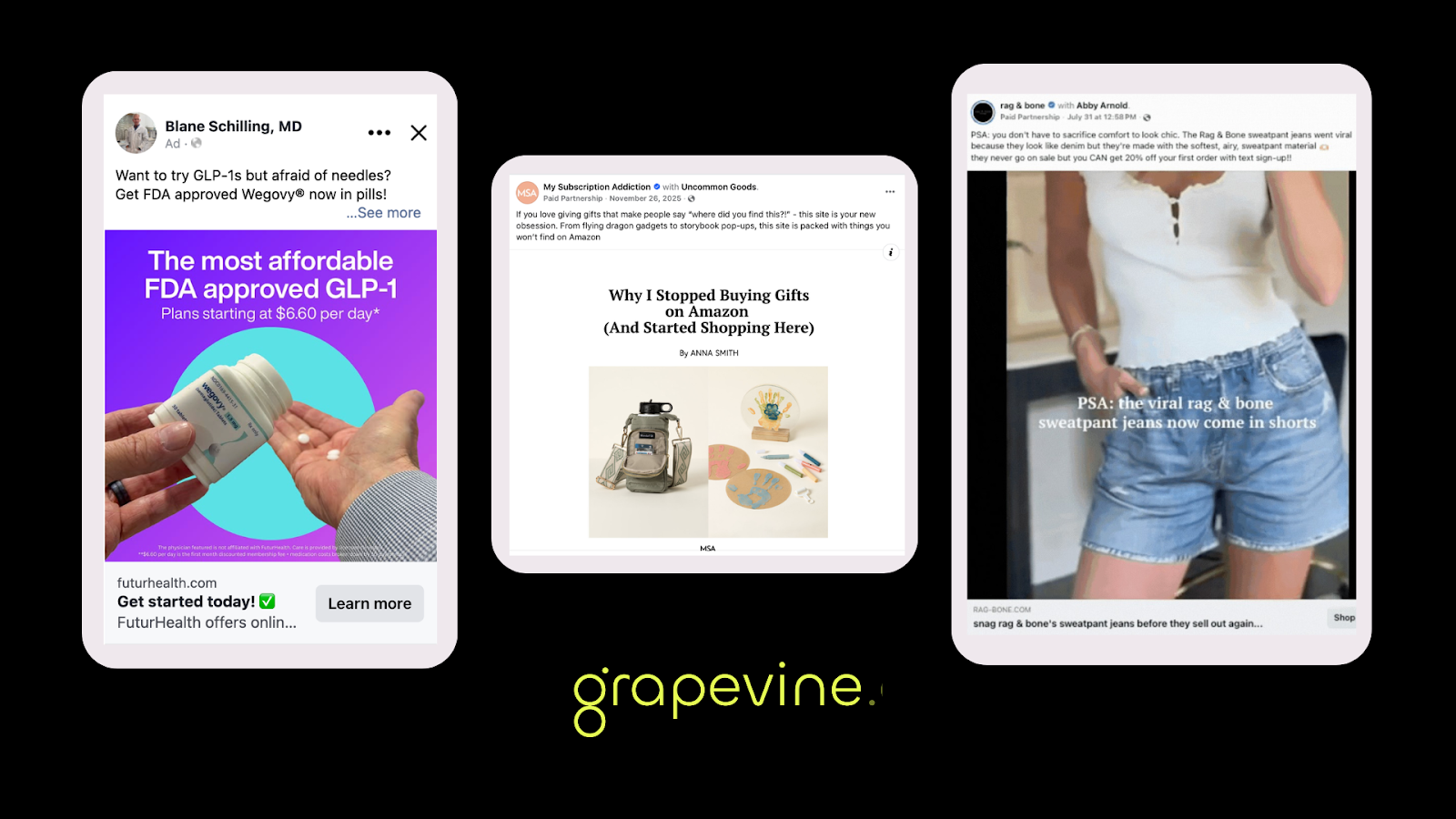
Today's buyer knows the difference between a brand speaking for itself and a credible voice speaking independently. Ads from branded handles are easy to discount.
A clinical pharmacist reviewing scrubs. A veterinarian recommending a supplement. A makeup artist breaking down an ingredient. That's harder to scroll past.
Grapevine works across some of the most trust-dependent categories - GLP-1s (Futurhealth), telehealth (Alloy), finserve (Better), and DTC (Fabletics, Particle for Men, Arrae) precisely because expert creator voice and publisher advertorial move audiences that branded creative can't.
- Just Food for Dogs scaled Grapevine assets from 15% to 45% of paid media in 6 months
- Madison Reed unlocked 20% efficiencies over Target CPA and 50% higher LTV
- Mathnasium cut Meta CPL by 33% in under 30 days
The brands winning right now are running both creator whitelisting and publisher advertorial whitelisting at the same shop, as one fully managed service.
No platform juggling. No separate agency relationships. Brief to launch, handled.
👉 Book a free strategy call for your first campaign strategy session - no commitment required.
📝 Use Creative as Your Targeting Engine
Targeting Meta is no longer about choosing the right audience. It is about creating the right ad. The shift is simple: creative now does the job that audience targeting used to handle.
Why creative drives performance:
Meta’s algorithm decides who sees your ads. Your role is to create content that attracts the right users. Strong creative signals intent, helping the system find high-quality buyers automatically.
Steps to use creative for targeting:
1️⃣ Start with broad targeting
Avoid over-segmentation. Broad audiences give the algorithm more room to optimize. Instead of controlling who sees your ad, focus on why they will care.
2️⃣ Use hooks to attract the right users
Your hook determines your audience
Pain-driven hooks attract problem-aware users
Lifestyle hooks appeal to aspirational buyers
Discount hooks bring in price-sensitive shoppers
3️⃣ Let messaging filter intent
Your copy acts as your qualifier. Different phrases speak to different personas, helping you narrow down users without manual targeting.
4️⃣ Test multiple creative angles
Shift from audience testing to creative testing. Run different variations with unique hooks, formats, and storytelling styles to give the algorithm more signals.
5️⃣ Launch a diverse creative mix
Start with 8 to 10 ads including product benefits, social proof, and offers. Use a mix of formats like videos, images, and user-generated content.
The Takeaway
Creative is the new targeting layer. When your ads clearly communicate value and speak to specific mindsets, the algorithm does the rest. Focus on better creative, and scaling becomes easier.
📝 Create a Full Product Shoot with Grok
Creating high-quality product photos usually requires expensive studios, lighting setups, and photographers. But with Grok’s Aurora model, you can now generate an entire product shoot that looks consistent and professional using just prompts.
Why this matters:
Consistency is what separates amateur visuals from premium brands. Instead of random product images, you can create a full set that looks like it was captured in one seamless shoot.
Steps to create your product shoot:
1️⃣ Start with a base image
Upload your product photo to Grok and prompt: Product photo on a matte black surface with soft box lighting from the upper left, shot on an 85mm lens with shallow depth of field. This sets the foundation for your entire shoot.
2️⃣ Maintain the same studio setup
When generating additional images, reuse the same prompt structure. Only change the angle or framing. Try variations like a 3/4 angle, close-up shots, or a clean white background to expand your set.
3️⃣ Build multiple angles
Create different perspectives while keeping lighting and styling identical. This ensures every image feels like part of the same collection.
4️⃣ Add a lifestyle scene
Prompt Grok to place your product in a real-world setting. Describe how it is used, whether worn, held, or placed in an environment. Include details about lighting and mood to match your original setup.
5️⃣ Review the full set
Lay out all generated images together. They should feel cohesive, as if they came from a single professional shoot.
The Takeaway
Grok makes professional product photography scalable. By keeping prompts consistent and building variations step by step, you can create a polished, high-converting product shoot without the cost or complexity of traditional methods.
We'd love to hear your feedback on today's issue! Simply reply to this email and share your thoughts on how we can improve our content and format.
Have a great day, and we'll be back again with more such content 😍