The science behind growth experiments
📈 What actually drives growth and build apps faster with integrated AI tools

Hello Readers 🥰
Welcome to today's edition, bringing the latest growth stories fresh to your inbox.
If your pal sent this to you, then subscribe to be the savviest marketer in the room😉
In Partnership with AirOpsStop satisfying the algorithm. Start getting retrieved.
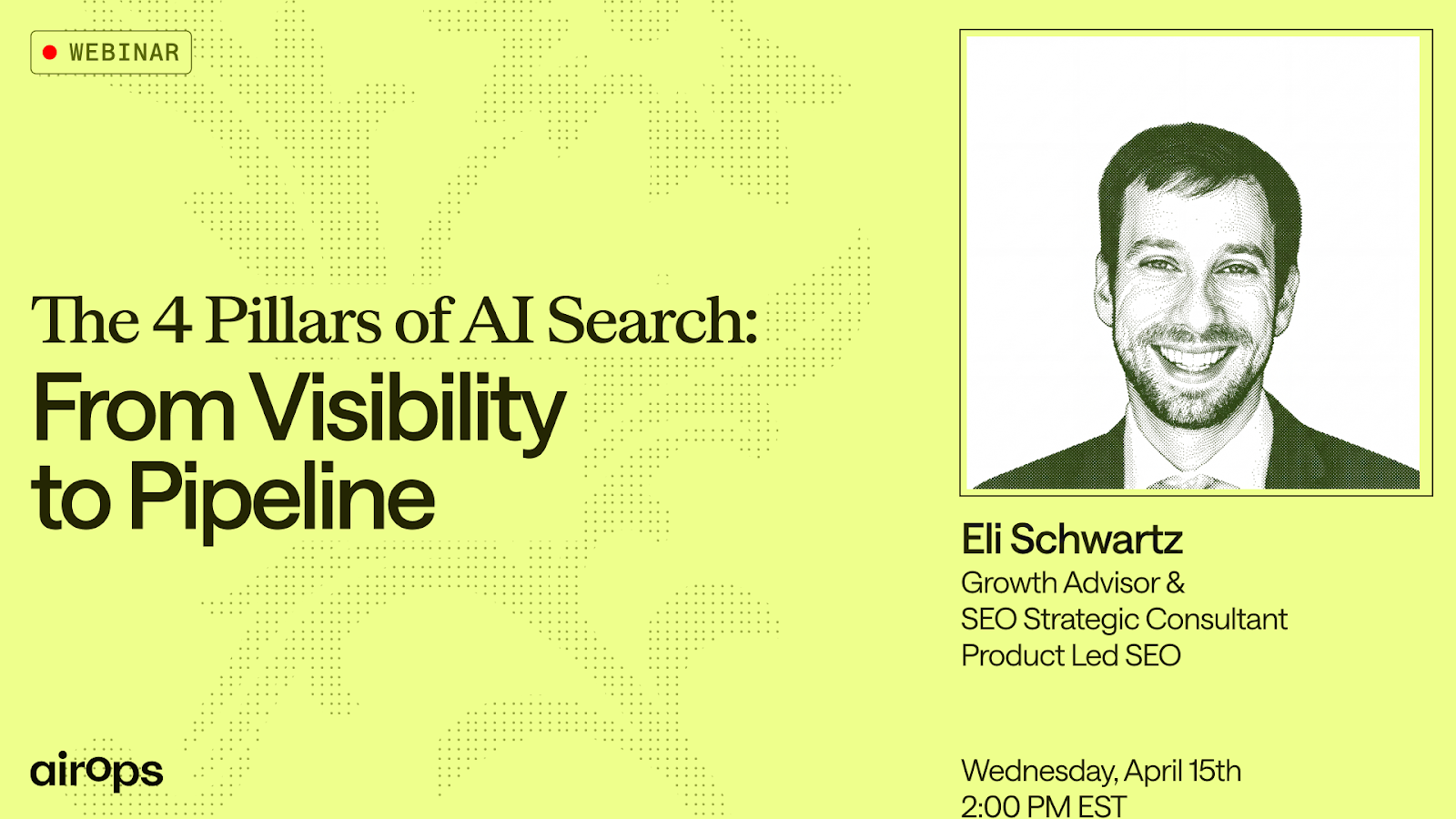
AI answers don't reward rankings. They pull from content that signals trust, structure, and relevance at the passage level. If your brand isn't being retrieved and cited, you're invisible where decisions are already being made.
Join AirOps on April 15th at 2 PM EST for a live session with Eli Schwartz, Growth Advisor and Author of Product-Led SEO.
Eli has created billions in organic search revenue, consulting with companies like Coinbase, Tinder, LinkedIn, Gusto, Quora, Zendesk, and more.
He’ll break down the exact framework he's shared with board rooms and VCs for how AI search is functioning now in 2026. You'll walk away knowing:
- The 4 pillars that determine whether AI retrieves your content
- How to identify the highest-leverage SEO stages to fix first
- Why deep customer research is still the most underused edge in AI visibility
One live session. A framework you can action the same week.
Can't make it live? Register anyway and get the recording within 24 hours.
📝 Build a High-Impact Experimentation System
Experimentation is not about running more tests. It is about learning faster.
Most teams confuse speed with impact. But the companies that grow fastest are the ones that generate the most meaningful insights, not the most experiments. Growth comes from understanding what works and why.
Steps to Run Smarter Growth Experiments:
1️⃣ Start with the Right Problems
You cannot test outcomes directly. Break your main goal into smaller inputs like conversion rate, activation, or retention. Identify where users drop off and turn those into clear problem statements.
2️⃣ Build Strong Hypotheses
Use customer insights, past data, and market research to form ideas. A strong hypothesis clearly explains what you believe and what result you expect.
3️⃣ Prioritize Ruthlessly
Resources are limited. Focus on ideas with the highest potential impact and strongest supporting evidence. Keep scoring simple and avoid overcomplicating decisions.
4️⃣ Design Minimum Viable Tests
Do not overbuild. Start with the simplest way to validate your idea. This could be user interviews, landing pages, or lightweight experiments before investing heavily.
5️⃣ Launch and Track Properly
Run your test with clean tracking. Check early for bugs, but avoid making decisions too soon. Let the test reach meaningful results before concluding.
6️⃣ Learn and Apply
The goal is not to win. It is learning. Analyse what worked, what did not, and why. Use those insights to refine your strategy and design better experiments.
The Takeaway
Experimentation is a long-term system, not a one-time tactic.
Focus on quality over quantity, and prioritise learning over short-term wins.
The teams that learn fastest ultimately build the strongest growth engines.
Your ROAS Is Lying to You
Revenue is up, and campaigns are scaling, yet ROAS reflects only platform efficiency. It does not account for processor fees, delayed refunds, fulfilment costs, or tax accumulating in the background. Without reconciled books, the margin becomes a projection.
When reconciliations lag or when inventory data sits in another system, gaps form between reported profit and actual cash. The strain surfaces later, often when a supplier invoice or payout delay compresses liquidity.
At MNH Advisory, they run disciplined monthly bookkeeping so your accounts are reconciled against real activity and your reporting reflects actual margin.
That gives you visibility without committing to a full-time $80K to $120K finance hire.
If you are spending aggressively to grow, your numbers should not lag.
Book your free strategy call today!
📝 Build Full Apps Inside One AI Ecosystem
Building apps used to mean juggling multiple tools, platforms, and workflows.
That is changing fast.
With the latest AI Studio updates, you can now design, build, and launch applications inside a single connected ecosystem. Instead of switching between design tools, backend services, and integrations, everything works together seamlessly.

Steps to Build Apps End to End:
1️⃣ Design Your App Visually
Start by designing your interface using Stitch. You can quickly create layouts, screens, and flows without needing deep design expertise. This becomes the foundation of your app.
2️⃣ Build Inside AI Studio
Once your design is ready, move into AI Studio to start building. This is where your app logic, structure, and functionality come together in one place.
3️⃣ Add a Database Layer
Use Firebase to manage your data. Whether it is user information, content, or app activity, you can easily store and retrieve everything without setting up complex backend systems.
4️⃣ Connect APIs and Services
Integrate external tools and services directly into your app. From payments to notifications, you can extend functionality without heavy development work.
5️⃣ Enable Seamless Authentication
Add sign-in with Google to simplify user onboarding. This reduces friction and helps users get started instantly without creating new accounts.
The Takeaway
App development is becoming more integrated and accessible.
When design, development, and infrastructure live in one ecosystem, you can move from idea to launch much faster.
We'd love to hear your feedback on today's issue! Simply reply to this email and share your thoughts on how we can improve our content and format.
Have a great day, and we'll be back again with more such content 😍