The Bias Behind Bad Choices
🔥 Stop cherry picking proof, then run compliant AI in a private Cohere vault

Hello Readers 🥰
Welcome to today's edition, bringing the latest growth stories fresh to your inbox.
If your pal sent this to you, then subscribe to be the savviest marketer in the room😉
In Partnership with Section
Free Event: AI ROI Conference on March 5

On March 5 from 2–3 PM ET, Section is hosting the AI:ROI Conference, a practical session for leaders responsible for making AI deliver real business results.
As leaders shift from funding experiments to demanding results in 2026, this is required learning for teams responsible for making AI pay off.
You’ll learn directly from AI pioneers who have already made the mistakes, worked through the complexity, and built repeatable paths to ROI, so you can fast-follow their playbook and set your 2026 AI strategy up for success.
Speakers include Brice Challamel, Head of AI Strategy and Adoption at OpenAI, Diane Igoche, Director of Agentforce Governance at Salesforce, and DJ Sampath, SVP of AI Software and Platform at Cisco.
📝 Use Base Rate Fallacy to Sell Smarter
Most customers think they make decisions logically. But in reality, their brains are constantly taking shortcuts. One of the most common mistakes people make is called the Base Rate Fallacy.
It happens when someone ignores the big-picture probability (the base rate) and instead focuses on one attention-grabbing detail.
A classic example shows why.
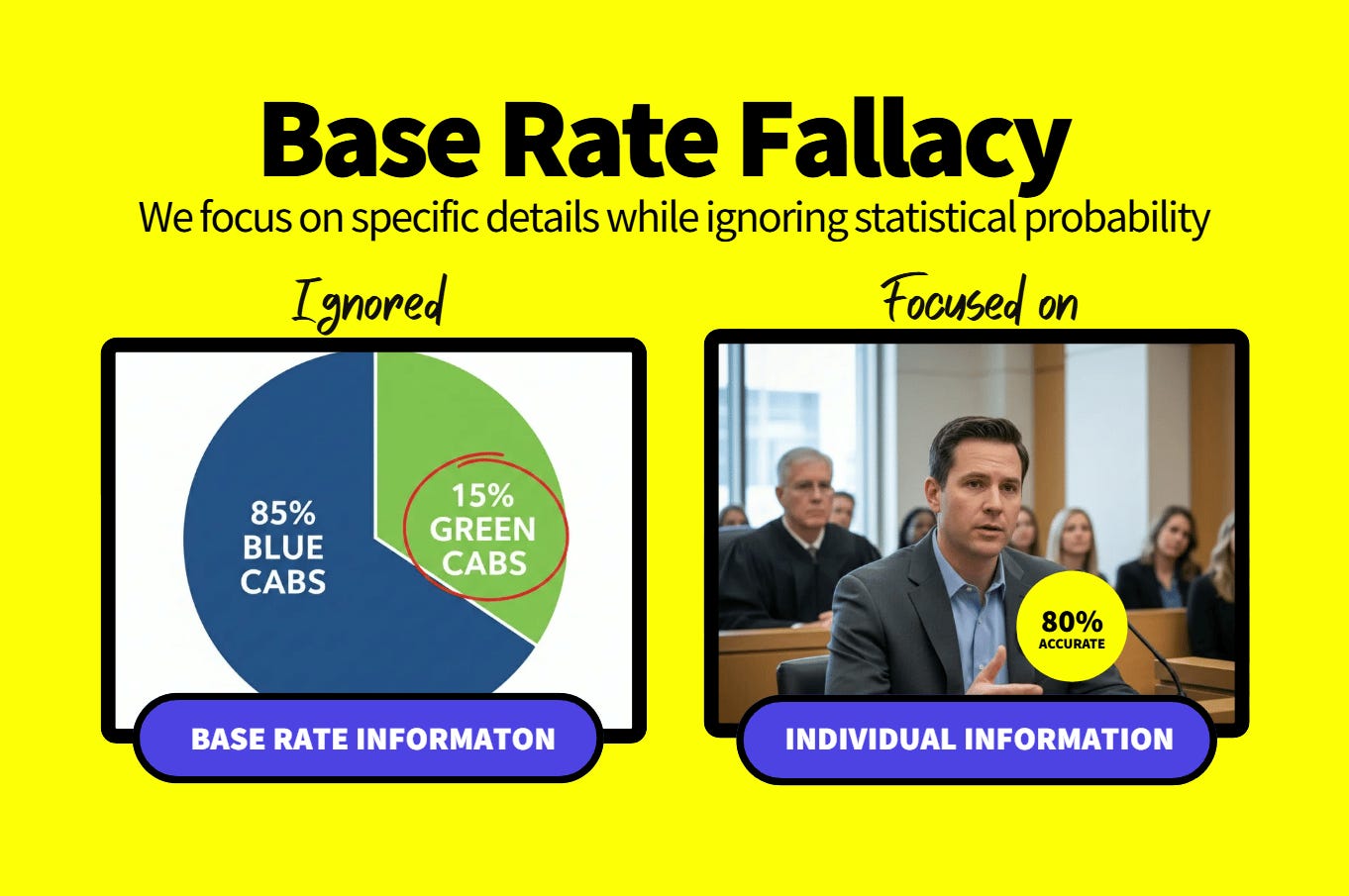
In a city with two cab companies, 85% of cabs are blue and only 15% are green. A hit-and-run happens at night. A witness says the cab was green. The witness is correct 80% of the time.
Most people assume: “If the witness is 80% accurate, the cab was probably green.”
But the real answer is closer to 41%.
Why? Because even if the witness is fairly accurate, green cabs are rare. The base rate still matters.
This is how customers think too.
They overweight specific details that feel meaningful (one testimonial, one influencer clip, one product feature) and ignore broader reality (overall satisfaction, total customer volume, typical outcomes).
Steps to Apply Base Rate Fallacy in Marketing
1️⃣ Lead With the Biggest Proof
Instead of showcasing one perfect review, highlight large-scale proof like total ratings or customer count.
2️⃣ Make the Base Rate Impossible to Miss
Put your strongest aggregate stat above the fold so it becomes the customer’s default assumption.
3️⃣ Use One Number as the Anchor
A single standout stat gives the brain a shortcut and reduces comparison shopping.
4️⃣ Avoid Cherry-Picked Evidence
A few generic testimonials feel easy to dismiss. A massive total feels harder to argue with.
5️⃣ Reduce Decision Fatigue
When the base rate looks strong, customers stop overanalyzing and commit faster.
The Takeaway
Customers don’t naturally evaluate probability. They evaluate what stands out. If you want more conversions, don’t just add more proof. Lead with the proof that makes satisfaction feel like the norm.
📝 Get AI Privacy Without Self-Hosting
For most teams, AI infrastructure has always come with an annoying tradeoff.
If you use public APIs, everything is fast to set up. But you deal with rate limits, unpredictable latency, and shared infrastructure that makes privacy and compliance harder.
If you self-host, you get control and isolation. But you also inherit the nightmare: GPU management, scaling headaches, uptime risk, and huge costs.
Model Vault by Cohere is designed to remove that tradeoff.
It gives you a fully private AI environment inside the cloud that feels like SaaS, but behaves like self-hosting. You get a dedicated setup without needing to manage your own machines, clusters, or infrastructure.
Think of it as your own isolated AI “vault” where models run inside your own dedicated environment, with no shared GPUs and no risk of data mixing.
This is especially valuable for regulated industries like finance, healthcare, and government, but it also matters for any team running sensitive workflows or internal data through AI.
Steps to Use Cohere Model Vault
1️⃣ Create Your Vault Environment
Start by creating your account and opening the Model Vault dashboard. This is where you’ll configure your private setup.
2️⃣ Choose Your Cohere Models
Select the models you want to run, including Cohere’s latest Command, Embed, and Rerank options. Everything runs inside your isolated environment.
3️⃣ Enable Single Tenancy
Your vault runs on dedicated infrastructure, meaning no shared GPUs, no noisy neighbors, and no cross-customer risk.
4️⃣ Set Scaling Limits
Model Vault supports elastic scaling, so bursty agentic workloads can expand without you provisioning machines.
5️⃣ Monitor Performance in Real Time
Use built-in dashboards to track latency, token usage, uptime, and overall performance without needing custom monitoring.
The Takeaway
Model Vault is the “finally” solution for teams that want AI privacy and compliance without becoming GPU janitors. It delivers the isolation of self-hosting with the speed and simplicity of SaaS, making secure AI scalable for real production workloads.
We'd love to hear your feedback on today's issue! Simply reply to this email and share your thoughts on how we can improve our content and format.
Have a great day, and we'll be back again with more such content 😍