Reframe the problem to win
🧠 How to win crowded markets with positioning, plus how to build offline coding assistants

Hello Readers 🥰
Welcome to today's edition, bringing the latest growth stories fresh to your inbox.
If your pal sent this to you, then subscribe to be the savviest marketer in the room😉
In Partnership with Creator.co
From Invisible to Irresistible: How UGC Helped This Brand Pop Off the Shelf

What if the biggest unlock for your CPG brand isn’t a packaging refresh or a promo blitz but creators telling the story your audience actually wants to hear?
That’s exactly what happened when this everyday grocery staple shifted from pushing polished product shots to activating creators across food, lifestyle, and everyday routines. The result wasn’t just content; it was momentum.
Delivering 560K+ views, 247K reach, 9K likes, 2K saves, and $58K EMV - all from authentic storytelling that felt like discovery, not advertising.
More importantly, it became repeatable. Mid-tier creators expanded visibility. Micro-influencers added warmth and trust.
And with Creator.co managing recruitment, briefs, and delivery, the brand built a scalable content engine, everything from 71K-view recipe videos to 600+ save snack hacks.
When UGC becomes the heart of your strategy, your product stops blending in and starts belonging in the lives (and carts) of your consumers.
👉 See how creator-led storytelling can fuel your brand’s next breakthrough →
🧠 Win Crowded Markets With A Better Story
In most saturated markets, your biggest enemy is not competitors. It is the category narrative that customers already believe. Every category comes with a default story that defines the problem before you ever show up. If you position yourself as faster, cheaper, or all-in-one, you reinforce that frame and become interchangeable.
That is why feature upgrades rarely fix growth. If your messaging stays inside the category box, customers file you under another one of those and move on.
The real battle is salience. People choose what comes to mind first. If the category owns the story, the incumbent wins by default because they already occupy that mental slot.
So what do breakout companies do differently?
They do not describe what they do better. They redefine the problem so the old category stops being the best answer.
Steps to Build a Reframe Ladder:
1️⃣ Start With The Obvious Problem
Write the standard problem your category claims to solve. This is the common assumption your competitors repeat.
2️⃣ Find The Deeper Problem Your Persona Feels
Look for the hidden tension under the surface. Often, it is emotional, operational, or tied to frustration, not features.
3️⃣ Show Why The Category Fails At That Deeper Problem
Expose the mismatch. The category may help people do more of something, without solving what actually slows them down.
4️⃣ Define The New Problem Only You Are Built To Solve
This becomes your narrative foundation. You stop sounding like everyone else because you are no longer answering the same question.
5️⃣ Translate The Reframe Into Messaging
Turn the new problem into a clear headline, a few supporting proof points, and simple hooks that show up across ads, landing pages, and sales.
The Takeaway
You do not need a better slogan. You need a better problem story. When you reframe the problem, you create salience, make incumbents feel misaligned, and earn a mental slot that competitors cannot copy.
🛠️ Run High Quality Coding Models Locally
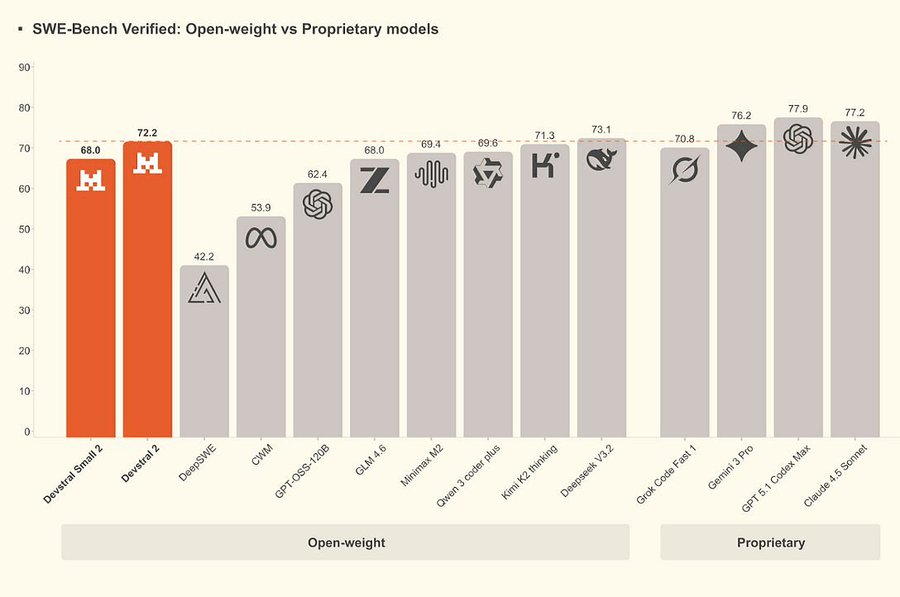
If you want private, on-device coding help without cloud dependencies, Mistral AI is worth paying attention to. A pair of open-weight coding models just dropped, including a compact option that is designed to run locally while still staying competitive on real coding tasks.
The headline: one model is 24B parameters and optimized for local deployment, fast iteration, and tight feedback loops. There is also a larger 123B model for heavier work when you have the computer.
Even better, there is a free command-line “vibe coding” assistant that plugs into this ecosystem so you can use it directly in your terminal and workflows.
Steps to Try Local Vibe Coding:
1️⃣ Pick Your Model Size
Choose the smaller model if you want local privacy and quick loops. Choose the larger model if you want maximum capability and can support the hardware needs.
2️⃣ Run It Locally
The 24B model is positioned as locally deployable, including setups like a Mac with 32GB RAM or a single high-end consumer GPU.
3️⃣ Use The Vibe CLI Workflow
Install the CLI and use it as a coding assistant in your terminal, so you can iterate on tasks without leaving your dev flow.
4️⃣ Keep Everything Private
Because the smaller model is built for on-device runtime, you can keep prompts, code, and context local when privacy matters.
5️⃣ Move From Experiments To Real Work
Start with small refactors, bug hunts, and multi-file changes, then expand once you trust the outputs and your tooling.
The Takeaway
Local coding models are getting genuinely practical. If you want privacy, unlimited iteration, and a CLI-first workflow, this setup gives you a clean way to do real work without living in the cloud.
We'd love to hear your feedback on today's issue! Simply reply to this email and share your thoughts on how we can improve our content and format.
Have a great day, and we'll be back again with more such content 😍